
Registration of Hindu Marriages
Section 8 of the Hindu Marriage Act does not create a marriage. It creates an official record of a marriage that has already been validly solemnised.
Lecture Video
Watch the lecture first, then use the bare provision, clause-wise explanation and case-law notes below for revision.
What is registration of marriage?
Registration of marriage means the official recording of the fact that a marriage has taken place. The entry is made in a public register maintained by the State through the competent Marriage Registrar, Sub-Registrar or other notified authority. After registration, a certified extract or marriage certificate may be issued.
The central purpose of registration is simple: to facilitate proof of marriage. It is useful in courts, administrative offices, passport and visa matters, service records, bank nominations, inheritance claims, maintenance proceedings, residence rights and many other situations where the factum of marriage has to be shown quickly and reliably.
The teaching distinction
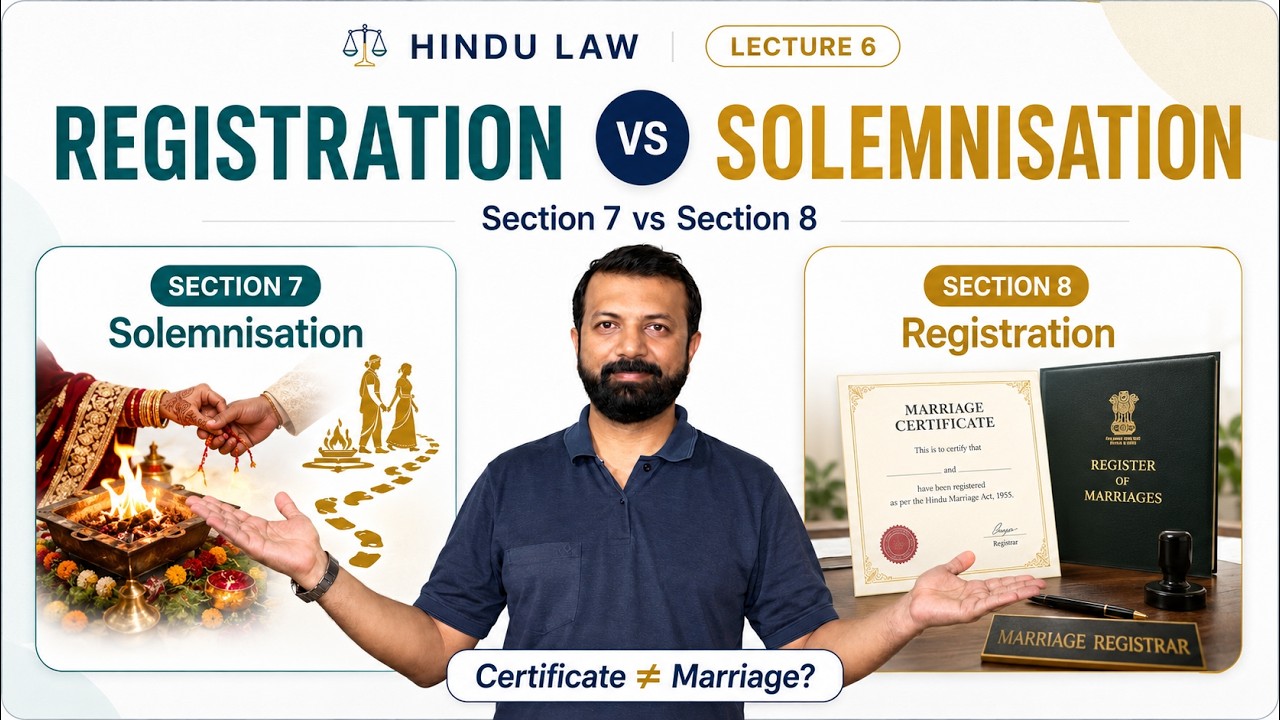
Section 7 deals with solemnisation of Hindu marriage. Section 8 deals with registration of Hindu marriage. Therefore, the first question is always: was there a valid Hindu marriage? Registration comes after that.
Section 8 explained
Registration of Hindu marriages — clause-wise explanation for students.
Rules for registration
For facilitating proof of Hindu marriages, the State Government may make rules allowing parties to enter particulars of their marriage in a Hindu Marriage Register.
Meaning: Section 8 starts with proof. It is not a section for performing marriage.
Compulsory registration by State
The State Government may make entry of marriage particulars compulsory in the whole State, in any part of the State, in all cases or in specified cases.
Contravention may attract a fine which may extend to twenty-five rupees.
Rules before Legislature
All rules made under Section 8 must be laid before the State Legislature as soon as may be after they are made.
Meaning: the rule-making power is subject to legislative oversight.
Register as evidence
The Hindu Marriage Register is open for inspection at reasonable times and is admissible as evidence of the statements contained in it.
Certified extracts may be given on application and payment of the prescribed fee.
Non-registration does not invalidate marriage
Nothing in Section 8 affects the validity of a Hindu marriage merely because the entry has not been made in the register.
Registration is not the same as solemnisation
Section 7: Solemnisation
- Concerns the actual performance of marriage.
- Marriage may be solemnised according to customary rites and ceremonies of either party.
- Where Saptapadi forms part of the ceremony, the marriage becomes complete when the seventh step is taken.
- It goes to the legal existence of the marriage.
Section 8: Registration
- Concerns entry of marriage particulars in a public register.
- It helps create reliable documentary proof.
- The register and certified extracts are admissible as evidence.
- It cannot create a marriage where no valid marriage took place.
To whom does Section 8 apply?
Section 8 applies to Hindu marriages, meaning marriages solemnised under the Hindu Marriage Act between persons to whom the Act applies. The expression “Hindu” in the Act includes, in the statutory scheme, persons who are Hindus as well as Buddhists, Jains and Sikhs, subject to the Act’s conditions and exceptions.
Because Section 8 is implemented through State rules, the authority, forms, documents, fee, witnesses, mode of appearance and compulsory-registration requirements may differ from State to State. Therefore, a lawyer must read Section 8 along with the relevant State rules or local registration law.
Important caution
A marriage between parties who do not fall within the application of the Hindu Marriage Act cannot be converted into a Hindu marriage merely by entering it in a Hindu Marriage Register. The Registrar records a legally registrable Hindu marriage; the Registrar does not manufacture one.
Typical steps for registration
The precise procedure depends on State rules, but the usual flow is as follows.
Application
The parties file the prescribed application before the notified Marriage Registrar or Sub-Registrar.
Documents
Identity proof, address proof, age proof, photographs, proof of solemnisation, and witness details are ordinarily required.
Verification
The authority verifies particulars. Depending on State rules, parties and witnesses may be required to appear and sign.
Entry in register
Once satisfied, the authority enters the particulars in the Hindu Marriage Register.
Certificate
A certified extract or marriage certificate is issued on payment of the prescribed fee.
Why obtain a marriage certificate?
Ready proof
A certificate avoids unnecessary disputes about the factum and particulars of marriage.
Protection of rights
It assists claims relating to maintenance, inheritance, residence, custody and service benefits.
Administrative convenience
It is commonly required for passport, visa, bank, insurance, nomination and employment records.
Social safeguards
Compulsory registration helps deter child marriage, bigamy, desertion and false denial of marriage.
Landmark decisions
These cases explain the legal effect, evidentiary value and social importance of marriage registration.
Seema v. Ashwani Kumar
Supreme Court of India · 2006
Why this case matters
Section 8 originally leaves much to State rules and also states that non-registration will not invalidate a Hindu marriage. Yet the Supreme Court treated registration of marriages as a major social-legal necessity, especially to reduce hardship caused by lack of proof.
Principle
The Court observed that marriages of Indian citizens belonging to various religions should be made compulsorily registrable in the States where they are solemnised. Registration gives evidentiary value and supports a presumption of marriage, though the presumption remains rebuttable.
Impact
The judgment pushed States and Union Territories to frame or amend rules, notify procedures, give publicity, invite objections and provide consequences for non-registration or false declarations.
Doly Rani v. Manish Kumar Chanchal
Supreme Court of India · 2024
Facts
The parties had obtained a certificate from a private entity and thereafter a certificate of registration under State rules. Later, it was accepted that the customary rites and ceremonies required for a Hindu marriage had not been performed.
Issue
Can a certificate or registration under Section 8 confer the legal status of husband and wife when the essential ceremonies under Section 7 never took place?
Held
No. Section 8 facilitates proof of a Hindu marriage already solemnised in accordance with Section 7. It cannot create or legitimise a marriage where no marriage ceremony occurred. In those facts, the certificates and registration were treated as null and void.
Other useful judicial propositions
These cases are useful because they directly deal with registration procedure, refusal of registration, or the legal nature of registration.
Nishana Mol N. v. Alappuzha Municipality
Kerala High Court · 2009
The question was whether both parties must be personally present before the Local Registrar under the Kerala Registration of Marriages (Common) Rules, 2008. The husband had gone abroad after the marriage, and the Registrar insisted on presence of both parties.
The Court held that the Rules deal with registration of marriages already solemnised; they do not themselves solemnise marriage. Therefore, personal appearance of both parties cannot be treated as the ordinary rule unless the Rules require it or the Registrar has a reasonable doubt about identity or materials.
Arunkumar v. Inspector General of Registration
Madras High Court · 2019
A Hindu male and a transwoman married in a temple according to Hindu rites and sought registration. The Registrar refused registration, partly on the ground that the second petitioner could not be treated as a “bride” under Section 5 of the Hindu Marriage Act.
The Court rejected that narrow approach. It held that a marriage solemnised between a Hindu male and a transwoman who identifies as a woman could be registered, and that the expression “bride” must be interpreted in light of constitutional values of dignity, autonomy and self-identification.
Five points to remember
Registration proves; it does not perform.
Section 8 of the Hindu Marriage Act gives a statutory framework for recording Hindu marriages in a public register and issuing documentary proof. Its importance has increased after judicial directions encouraging compulsory registration of marriages across States. But its legal nature remains evidentiary. The foundation of a Hindu marriage lies in valid solemnisation under Section 7. Therefore, a registration certificate is powerful evidence of a marriage, but it is not a magic document that can create a marriage in the absence of essential ceremonies.