
Background to the Hindu Marriage Act, 1955
Before reading the provisions of the Hindu Marriage Act, 1955, it is important to understand the older Hindu concept of marriage, the role of customs and ceremonies, the sacramental character of Hindu marriage, the movement of social reform and the reason why codification became necessary.
Where we reached in Hindu Law
In the earlier lectures, we studied who is a Hindu, the sources of Hindu Law, the Mitakshara and Dayabhaga schools, and the doctrine of pious obligation. These topics helped us understand the classical and largely uncodified background of Hindu personal law.
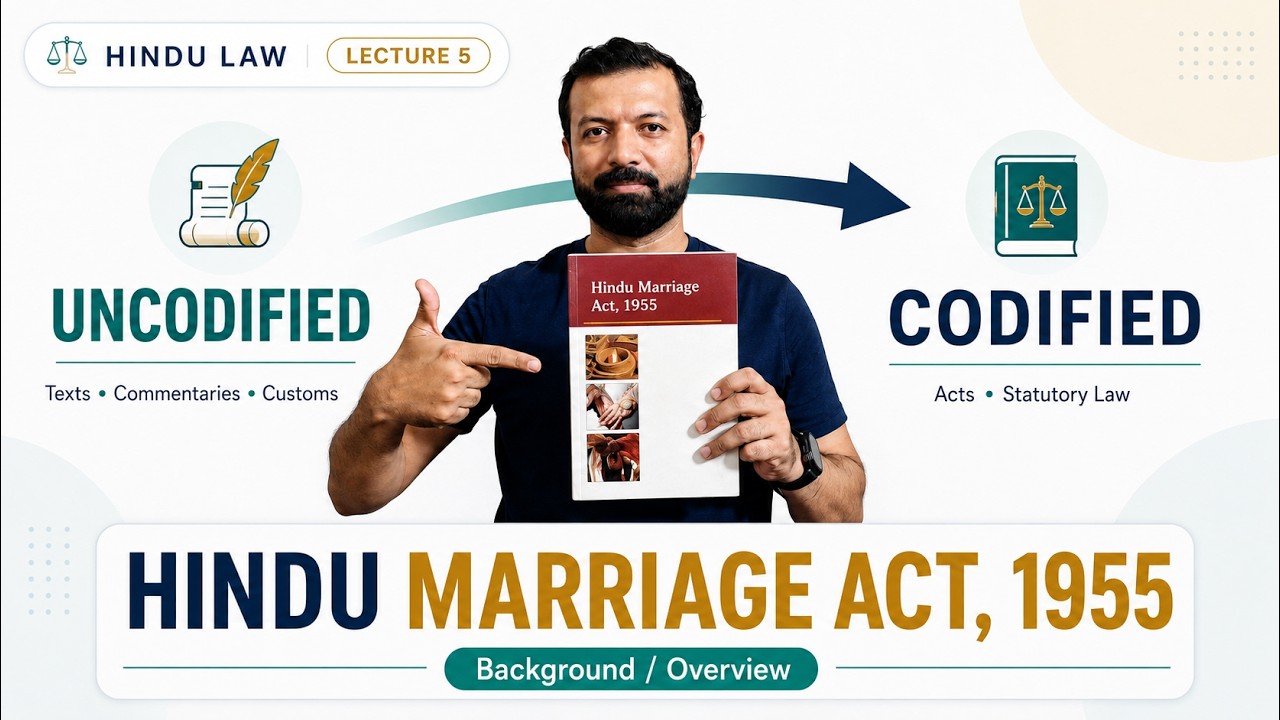
The doctrine of pious obligation also showed us an important point: ancient religious or moral principles may have historical value, but their modern legal enforceability depends on statute, recognised custom and judicial interpretation. From this lecture, we move from that uncodified background to codified Hindu Law.
Video Lecture
How to approach the Hindu Marriage Act, 1955
Watch this introductory lecture before beginning the provision-wise study. The aim is to understand why Hindu marriage law was codified and what background a student or lawyer must know before reading the Act.
Why this background is necessary
The Hindu Marriage Act, 1955 did not appear in isolation.
Hindu marriage law developed through religious texts, customs, ceremonies, community practices, social reform and judicial interpretation. If a learner directly starts reading the sections of the Act, the words may be understood, but the reason behind those provisions may remain unclear.
This is why background matters. Before entering the Act, we must understand how Hindu marriage was traditionally understood, why ceremonies were important, why custom played a serious role, and why a codified statute became necessary in a modern legal system.
How we will study this Act
Reading a bare Act is not like reading a storybook.
The Hindu Marriage Act should not be studied as a mechanical section-by-section reading exercise. Law is better understood concept-wise. First, we will take a legal concept, understand the practical problem behind it, and then connect that concept with the relevant provisions of the Act.
For example, when we study registration of marriages, we will not merely read Section 8. We will first ask practical questions: Why is registration important? Does non-registration make a Hindu marriage invalid? What is the evidentiary value of registration? This approach makes the study useful for both learners and lawyers.
Understand the concept
Start with the legal idea and the real issue behind it.
Read the provision
Then connect the concept with the exact statutory language.
Apply it to facts
Finally, test how the provision works in an actual matrimonial dispute.
Marriage as a legal and social status
Marriage is not merely a private arrangement between two persons.
Status of husband and wife
Once a marriage is recognised by law, the parties acquire the status of husband and wife. They are not treated merely as two individuals living together. Legal rights, duties and consequences arise from that recognised marital status.
Status of children and family
Marriage also affects children and the family structure. Questions of legitimacy, custody, maintenance, succession and sometimes property consequences may depend on the existence and validity of marriage.
Hindu marriage: sacrament, contract and civil consequences
The traditional and modern views must be understood together.
Traditionally, Hindu marriage was treated primarily as a sacrament. It was connected with religion, sacred duties, family obligations, ceremonies and spiritual ideals. It was not looked at merely as an ordinary agreement between two persons.
At the same time, modern law recognises that marriage produces civil consequences. It can affect maintenance, custody, legitimacy, inheritance, property issues, matrimonial remedies and court procedure. The better understanding is that Hindu marriage has a strong sacramental background, but modern law regulates its civil and legal consequences.
Traditional emphasis
Religious ceremony, sacred union, family duty, social recognition and spiritual obligation.
Modern legal emphasis
Status, rights, remedies, proof, maintenance, custody, validity and court process.
Role of ceremonies, rites and custom
Codification did not completely erase the importance of marriage ceremonies.
In traditional Hindu Law, ceremonies and rites were central to marriage. Different communities followed different practices. Some marriages were performed according to shastric rites, while some were performed according to customary ceremonies.
Even after codification, ceremonies and customs did not become irrelevant. In an actual matrimonial dispute, the court may still ask whether the marriage was solemnised, whether the necessary ceremonies were performed, whether a recognised custom existed, and how the marriage is proved.
Old forms of Hindu marriage
Ancient classifications are background, not the starting point of modern statutory study.
Ancient Hindu Law discussed different forms of marriage. These classifications are useful because they show how Hindu marriage developed through religious and social practices. But a modern student should not get lost in ancient categories before understanding the statutory framework.
The modern approach is different. The law does not ask only which ancient form of marriage was followed. It asks whether the marriage satisfies the requirements recognised by statute and whether it has been validly solemnised according to law. Historical background helps us understand the subject, but statutory provisions decide modern legal issues.
Why codification became necessary
The law needed clarity, uniformity and statutory remedies.
Before codification, questions of Hindu marriage could depend upon religious texts, commentaries, schools of law, local customs, community practices and judicial decisions. This sometimes created uncertainty for students, lawyers, courts and litigants.
Codification helped convert important principles of Hindu marriage law into statutory form. It brought clarity, supported reform, reduced uncertainty and provided a structured legal framework for matrimonial disputes.
Clarity
Rules became easier to locate, read and apply.
Uniformity
Dependence on scattered customs and regional interpretations was reduced.
Reform
The law could modernise marriage rules while preserving relevant social realities.
Remedies
Matrimonial disputes could be addressed through statutory remedies and courts.
A major background change: monogamy
The Act moved Hindu marriage law towards one husband and one wife as the rule.
Before codification, monogamy was not a strict legal requirement among Hindus in the way it is today. In many communities, a Hindu man having more than one wife was socially accepted or at least legally tolerated, while the same freedom was not equally available to women.
The Hindu Marriage Act, 1955 brought a major statutory change. It required that at the time of marriage, neither party should have a spouse living. In simple words, one husband and one wife became the legal rule. This background helps us appreciate why the Act was not merely a codification exercise, but also a reforming legislation.
Objective of the Hindu Marriage Act, 1955
The Act was enacted to amend and codify the law relating to marriage among Hindus.
The central objective of the Hindu Marriage Act, 1955 is to bring the law relating to marriage among Hindus into a clear statutory form. It is not merely a collection of old rules. It creates a modern legal framework for regulating Hindu marriage.
The Act gives structure to questions relating to application of the Act, valid marriage, ceremonies, registration, matrimonial reliefs, nullity, divorce, maintenance, custody, jurisdiction and procedure. For a learner of Hindu Law, this Act marks the beginning of statutory study after understanding the traditional background.
Important sections of the Hindu Marriage Act, 1955
Keep this as a roadmap before beginning detailed concept-wise study.
| Section | Broad topic | Why it is important |
|---|---|---|
| Section 2 | Application of the Act | Helps identify who is governed by the Hindu Marriage Act. |
| Section 3 | Definitions | Defines important expressions used throughout the Act. |
| Section 4 | Overriding effect | Shows the importance of the statute where the Act applies. |
| Section 5 | Conditions for Hindu marriage | Central provision for understanding validity of marriage. |
| Section 7 | Ceremonies for Hindu marriage | Important for solemnisation and proof of marriage. |
| Section 8 | Registration of Hindu marriages | Important for record, proof and practical documentation of marriage. |
| Section 9 | Restitution of conjugal rights | A major matrimonial remedy under the Act. |
| Section 10 | Judicial separation | Allows legal separation without immediate dissolution of marriage. |
| Sections 11 and 12 | Void and voidable marriages | Important for nullity and consequences of invalid marriages. |
| Sections 13 and 13B | Divorce and mutual consent divorce | Core provisions relating to dissolution of marriage. |
| Section 17 | Punishment of bigamy | Connects Hindu marriage law with the consequences of second marriage during subsistence of first marriage. |
| Section 19 | Court to which petition shall be presented | Important for deciding the proper court or jurisdiction for filing matrimonial petitions under the Act. |
| Section 22 | In-camera proceedings and publication restriction | Important because matrimonial proceedings are to be conducted privately and publication of matters relating to such proceedings is restricted, subject to the Act. |
| Sections 24 and 25 | Maintenance and permanent alimony | Important financial reliefs in matrimonial proceedings. |
| Section 26 | Custody of children | Relevant where matrimonial disputes involve children. |
| Section 27 | Disposal of property | Important where the court has to deal with property presented at or about the time of marriage and belonging jointly to both spouses. |
Where we will go from here
The next lecture will begin the concept-wise study of the Act.
After understanding the background, objective and structure of the Hindu Marriage Act, we will begin the detailed study of the Act. The next lecture will deal with registration of marriages and its practical importance in Hindu matrimonial law.
We will discuss a common practical question: if a Hindu marriage is not registered, does it become invalid? That question will help us understand why registration is important, but also why registration and validity are not always the same issue.
Social reform before codified Hindu marriage law
The Hindu Marriage Act, 1955 came after earlier reform efforts.
The Hindu Marriage Act was part of a larger movement of legal reform. Before 1955, several legislative changes had already touched different aspects of marriage. These reforms show a gradual movement from purely traditional regulation towards statutory reform.
Widow remarriage
Recognition of remarriage challenged older restrictions and marked an important social reform in Hindu matrimonial law.
Child marriage restraint
Legislation began controlling the age and social consequences of child marriage.
Inter-caste and inter-sect marriages
Marriage validity was gradually protected from objections based only on caste, sect or community barriers.
Civil marriage
Special marriage legislation created a civil route to marriage beyond strict personal-law ceremonies.