
What exactly is an “Industry”?
The answer has travelled from a short statutory definition in 1947, through the transformative Bangalore Water Supply decision of 1978, an unimplemented parliamentary amendment, and finally to Section 2(p) of the Industrial Relations Code, 2020 and the Supreme Court's nine-judge clarification in 2026.
A factory obviously looks like an industry. But what about a hospital, university, municipality, charitable trust or lawyer's office?
Labour law does not answer that question by looking at the signboard outside the building. It asks what activity is actually being carried on, how it is organised, who performs it and which statutory regime governs the dispute.
Why does this classification matter?
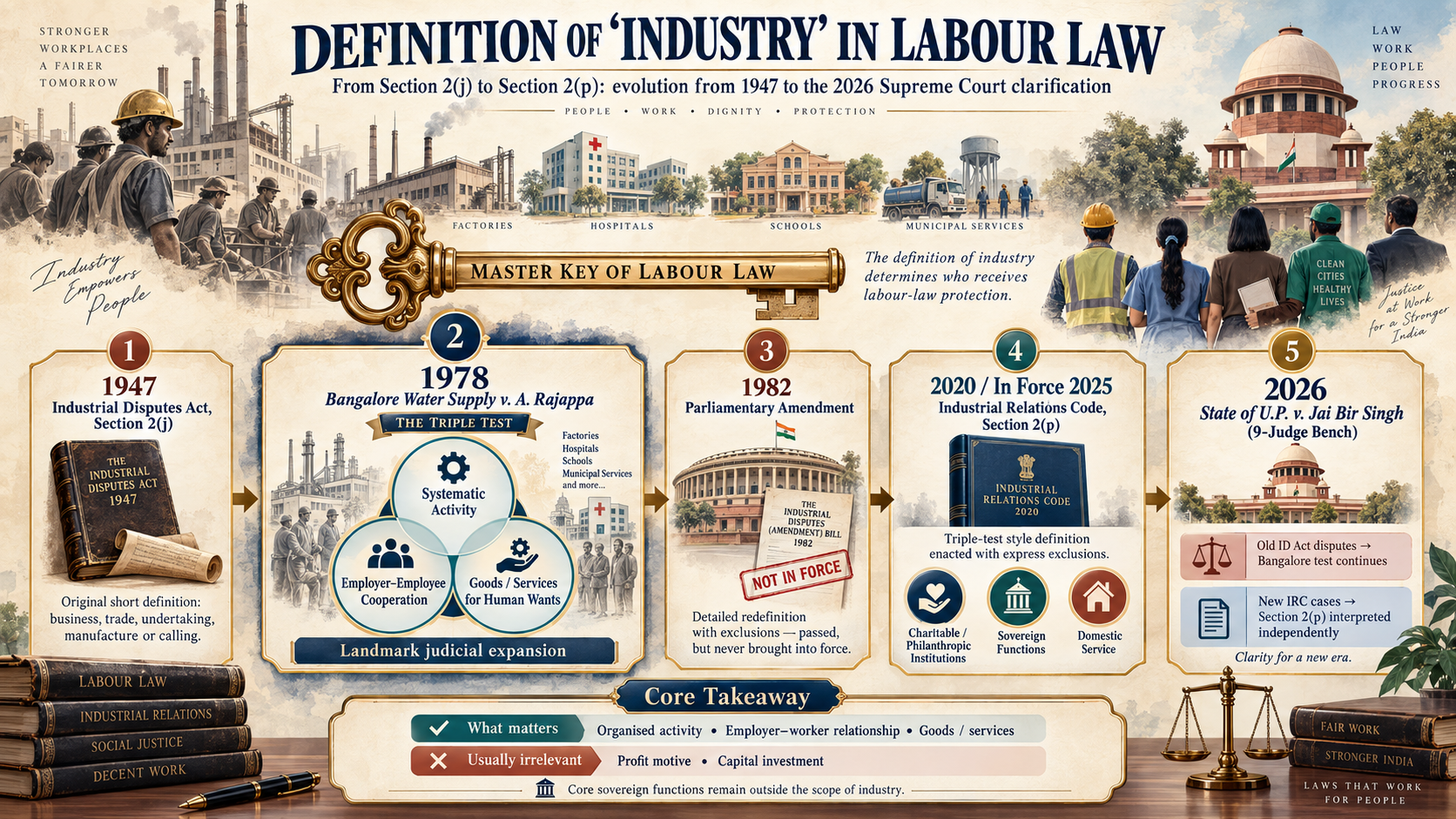
One definition determines the gateway to an entire statutory regime.
See the evolution before studying the details
If this sequence is clear, the entire topic becomes much easier.
Industrial Disputes Act
Section 2(j) used broad expressions such as business, trade, undertaking, manufacture and calling.
Bangalore Water Supply
Seven judges produced the famous Triple Test and Dominant Nature Test.
Parliament responds
Parliament enacted a detailed replacement definition, but the new definition never became operative.
Jai Bir Singh
A five-judge Bench questioned the breadth of Bangalore and sought reconsideration by a larger Bench.
Industrial Relations Code
Section 2(p) came into force on 21 November 2025.
State of U.P. v. Jai Bir Singh
Old ID Act disputes remain governed by Bangalore. The new Code must be interpreted independently.
Why does the definition of “industry” matter so much?
Before applying industrial-relations protections, the legal system must first know whether the activity falls inside the statutory field.
The “master key” idea
The definition is jurisdictional in a practical sense. If the activity does not fall within the governing concept of industry, the special industrial-dispute framework may not be available.
“Does this place look like a factory?”
“What organised activity is being carried on, through whose cooperation, for what output, and under which statutory regime?”
Section 2(j) of the Industrial Disputes Act, 1947
The original operative definition was surprisingly short. That brevity produced decades of litigation.
The definition had two sides
These words described the activity from the employer's side.
The inclusive second limb looked at the occupational side of the workmen.
The judicial pendulum
Before Bangalore Water Supply, Supreme Court decisions did not travel in one straight line.
D.N. Banerji v. P.R. Mukherjee
Municipal activity could fall within “industry”. Governmental ownership was not by itself decisive.
Hospital Mazdoor Sabha
A government-run hospital was treated as an industry. Profit motive was not essential.
University of Delhi v. Ram Nath
Educational institutions were held outside the concept. The Court emphasised the distinctive nature of education.
Madras Gymkhana Club
A members' club was held not to be an industry despite its organised activities and employees.
Safdarjung Hospital
The Court moved toward a more commercial/trade-analogy conception and narrowed the hospital approach.
Similar institutions could receive very different answers depending upon which line of authority was followed.
A larger Bench was needed to bring conceptual order.
Bangalore Water Supply & Sewerage Board v. A. Rajappa
A seven-judge Bench transformed the law by creating a functional framework rather than deciding industries by labels.
The central shift
Stop asking whether the institution is called a hospital, school, club, municipality or profession. Examine the nature and organisation of the activity.
The Triple Test
A prima facie industry exists when these three elements come together.
Systematic Activity
The activity must be organised, structured and carried on in a regular manner rather than casually or accidentally.
Employer–Employee Cooperation
The activity must involve organised cooperation between the employer and employees in carrying out the enterprise.
Goods or Services for Human Wants
The activity must produce or distribute goods or render services calculated to satisfy human wants and wishes, excluding wants that are merely spiritual or religious.
What Bangalore said was generally irrelevant
Profit motive
An activity does not cease to be industrial merely because it is run on a no-profit basis.
Capital investment
Heavy capital investment is not an indispensable ingredient.
Public or private ownership
Government ownership does not automatically convert an otherwise industrial activity into a sovereign function.
Charitable label
Under the old Bangalore regime, charity alone was not an automatic immunity from industrial law.
The decisive enquiry is into the nature of the activity, not merely the identity of the person or institution carrying it on.
The Dominant Nature Test
What happens when a single institution performs both industrial and non-industrial activities?
Look at the predominant nature of the integrated undertaking.
Where several departments form one integrated organisation, the dominant character of the undertaking may colour the whole.
Severable units may be treated separately.
If a distinct unit performs an industrial activity and can genuinely be separated from the rest, it may receive independent treatment.
University + commercial printing unit
Ask whether the printing activity is merely integrated into the institution or is a substantial and severable undertaking operating in its own right.
Sovereign functions
Bangalore did not treat every governmental activity as industrial. The exclusion was directed toward genuinely sovereign or inalienable functions of the State.
Classic examples include core administration of justice, defence and essential governmental authority.
A water board, transport undertaking or welfare department cannot escape the test merely by saying: “We are Government.”
Institutions traditionally thought to be “non-industrial”
Hospitals
Could qualify even without profit motive where the activity was systematically organised with salaried employees.
Educational institutions
Bangalore rejected the blanket exclusion of institutional education from the definition of industry.
Clubs
The label “members' club” was not enough to create automatic immunity if the functional test was otherwise satisfied.
Liberal professions
A large organised professional establishment could fall within the concept; a solitary practitioner with marginal assistance stood on a different footing.
Research bodies
Research did not receive a blanket exclusion merely because its end product was intellectual rather than a conventional commodity.
Government bodies
Economic or welfare activities could still qualify unless they genuinely fell within the sovereign-function exception.
Bangalore did not simply say “charity = not industry”
Justice Krishna Iyer differentiated between different kinds of charitable activity.
Business earns profit → profit goes to charity
The charitable destination of the surplus does not alter the industrial character of the productive activity.
INDUSTRYNo profit → salaried workforce supplies goods/services
Employees still contribute labour in an organised employer–employee relationship.
INDUSTRYHumanitarian mission → substantially volunteer driven
Where service is inspired by mission rather than an ordinary master–servant structure, the industrial character may disappear.
ORDINARILY OUTSIDEThe 1982 Amendment: enacted, but never brought into force
This is the bridge between Bangalore Water Supply and the modern statutory Code—and one of the most frequently misunderstood parts of the topic.
What Parliament attempted
Parliament enacted a much more detailed replacement for Section 2(j). Its structure adopted much of the language associated with systematic activity, employer–workman cooperation and the production, supply or distribution of goods and services.
This proposed definition did not become operative law
Although Parliament enacted the replacement, commencement depended upon executive notification. The relevant definition was never brought into operation under the old Industrial Disputes Act.
The proposed amendment expressly contemplated exclusions
Among its proposed exclusions were several areas that had generated controversy under Bangalore.
State of U.P. v. Jai Bir Singh — Five-Judge Bench
The Supreme Court expressed serious reservations about the extraordinary breadth of Bangalore Water Supply and considered whether the seven-judge precedent required reconsideration.
The matter ultimately travelled through larger-Bench proceedings and was eventually placed before nine judges.
Industrial Relations Code, 2020 — Section 2(p)
The Code came into force on 21 November 2025. We must now begin with Parliament's new statutory text rather than automatically beginning with Bangalore.
Under the present Code, ask five questions
Is there a systematic activity?
The activity must have an organised and continuing character.
Is it carried on through employer–worker cooperation?
The definition expressly contemplates workers employed directly or through an agency, including contractors.
Are goods or services produced, supplied or distributed?
The statutory focus is on the functional output of the activity.
Does the output satisfy human wants or wishes?
Wants that are merely spiritual or religious in nature are expressly distinguished.
Does an express exclusion apply?
This is now critical because Parliament itself has written exclusions into the definition.
Two things do not decide the issue
The activity can fall within the definition whether or not capital has been invested.
The definition does not depend upon the activity being carried on for profit.
Section 2(p) now tells us what Parliament wants kept outside
Charitable / social / philanthropic institutions
Institutions owned or managed by organisations wholly or substantially engaged in charitable, social or philanthropic service are expressly excluded.
Sovereign governmental functions
Activities relatable to sovereign functions are excluded, including specified Central Government activities concerning defence research, atomic energy and space.
Domestic service
Domestic service is expressly placed outside the statutory definition.
Other notified activities
Parliament has also empowered the Central Government to notify other activities for exclusion.
The Triple-Test style language survives, but the statutory exclusions now matter independently.
That is why a charitable hospital hypothetical cannot be answered today simply by repeating the 1978 conclusion.
Section 2(r): severability and predominant activity
The Code separately defines an “industrial establishment or undertaking” and provides a statutory method for establishments carrying on several activities.
If an industrial unit can genuinely be separated from non-industrial units, it may be treated as a separate industrial establishment.
If the predominant activity is industrial and the other activities are inseparable or aid that predominant activity, the whole establishment may acquire that character.
State of U.P. v. Jai Bir Singh — Nine-Judge Bench
2026 INSC 897 · decided 20 August 2026. The judgment is much more nuanced than saying that “Bangalore was overruled” or that “the new definition was void”.
Forty-eight years after Bangalore, what did the Court actually do?
By the time the reference was finally decided, the legal landscape had fundamentally changed: Section 2(j) had been repealed and Section 2(p) of the Industrial Relations Code was already in force.
“The Supreme Court declared the new definition void.”
The Court did not invalidate Section 2(p) of the Industrial Relations Code.
Understanding the 4–4–1 structure
Refine the Triple Test
This opinion proposed that the relevant goods or services should possess a discernible commercial character analogous to trade or business, while still not making actual profit indispensable.
Bangalore's Triple Test remains correct
These judges defended the essential Bangalore framework and did not accept the proposed commercial-character reformulation.
Do not unsettle the old regime now
With Section 2(j) already repealed, it was unnecessary to create a new formulation merely for the remaining old-law disputes.
Two legal lanes now exist
Apply Bangalore Water Supply
Pending disputes governed by the repealed Industrial Disputes Act continue to be determined using the Section 2(j) jurisprudence of Bangalore Water Supply.
Begin with Section 2(p) itself
The new statutory definition is to be interpreted independently in accordance with its own language, exclusions, structure and contemporary industrial context.
Bangalore remains the anchor for surviving old-ID-Act disputes, but it is not an automatic sheet anchor for interpreting Section 2(p) of the new Code.
Now classify the institution
Do not guess by intuition. First identify the applicable legal regime, then walk through the test.
Use this every time you see an “Is X an industry?” problem
Old ID Act or current IR Code?
Is it systematic and organised?
Employer + organised workers?
Goods or services satisfying human wants?
Does an express statutory exclusion apply?
Is the person legally a worker and is there a dispute?
A charitable hospital
It provides free treatment, runs on donations and employs salaried doctors, nurses, technicians, clerks and support staff through an organised management structure.
Apply the law
Under Bangalore / old ID Act: absence of profit would not by itself exclude the hospital. An organised salaried undertaking rendering services could satisfy the Triple Test.
Under current Section 2(p): first examine the express exclusion concerning institutions owned or managed by organisations wholly or substantially engaged in charitable, social or philanthropic service.
A corporate multi-speciality hospital
It operates continuously through hundreds of employees and provides organised medical and diagnostic services for consideration.
Apply the law
The activity strongly presents the characteristics identified in Section 2(p): systematic organisation, employer-worker cooperation and provision of services satisfying human wants.
But always separately ask whether a particular claimant is a statutory worker and whether any specific exclusion applies.
A lawyer with one clerk
A sole practitioner personally performs all legal work with assistance from one clerk who handles files and appointments.
Apply the law
Bangalore itself recognised the distinction between an organised professional establishment and a solitary professional practice with marginal employee engagement.
A single practitioner with isolated assistance was not the organised labour structure contemplated by the industrial concept.
A 300-person law firm
It has lawyers, researchers, paralegals, librarians, clerks, IT staff, accounts, HR and administrative divisions functioning as an integrated organisation.
Apply the law
Under the Bangalore functional approach, a professional label could not itself immunise an organised undertaking from the definition.
Under the current Code, however, analyse Section 2(p) independently rather than simply declaring that Bangalore controls the result.
A municipal water-supply undertaking
Hundreds of employees operate treatment plants, pipelines, maintenance systems, billing and distribution networks.
Apply the law
Bangalore is the classic reminder that governmental ownership alone is not the test. Water and sewerage operations may possess the functional characteristics of industry.
Under Section 2(p), ask whether the activity is genuinely relatable to the statutory sovereign-function exclusion. Do not equate “Government” with “sovereign”.
University + commercial printing division
A university maintains its educational departments but also operates a large printing division undertaking commercial work for external customers.
Apply the law
Under the old jurisprudence, examine the dominant nature and whether the industrial activity is severable.
Under the new Code, Section 2(r) expressly requires attention to severability and predominant activities in mixed establishments.
Police administration
Police personnel and administrative machinery perform core coercive law-and-order functions of the State.
Apply the law
This lies at the heart of the sovereign-function distinction. The present Code itself expressly excludes governmental activities relatable to sovereign functions.
A temple and its commercial guesthouse
The temple performs worship but also operates a separately managed, large paid guesthouse employing full-time hospitality staff.
Apply the law
Do not stop at the word “temple”. Merely spiritual or religious wants stand differently from organised material services.
The guesthouse raises a separate functional and severability enquiry. Under the current Code, the statutory text and any applicable organisational exclusion must be examined.
What changed—and what did not?
| Point | Original 1947 Act | Bangalore 1978 | 1982 Amendment | Current IRC | 2026 SC position |
|---|---|---|---|---|---|
| Legal source | Section 2(j) | Judicial interpretation | Act 46 of 1982 | Section 2(p) | 2026 INSC 897 |
| Core language | Business, trade, undertaking, manufacture, calling etc. | Triple Test | Detailed systematic-activity formulation | Systematic activity + employer-worker cooperation + goods/services | New Code must be read independently |
| Profit motive | Judicially debated | Not decisive | Not decisive | Expressly not decisive | No contrary rule for current Code |
| Charitable bodies | Uncertain | No blanket exemption | Proposed exclusion | Express statutory exclusion of specified institutions | Read Section 2(p), not Bangalore automatically |
| Sovereign functions | Developed judicially | Narrow exception | Express treatment proposed | Express statutory exclusion | New Code controls future cases |
| Status | Repealed | Controls surviving old-law disputes | Never commenced | CURRENT LAW |
Old disputes → Bangalore New disputes → Section 2(p) |
Remember the story—not isolated definitions
The chronology itself is the mnemonic.
Broad original Section 2(j)
Bangalore Triple Test
Amendment enacted, not commenced
Jai Bir Singh reference
Section 2(p) comes into force
Nine-judge Supreme Court
47 Text → 78 Test → 82 Attempt → 05 Doubt → 25 Code → 26 Clarify
Was the Triple Test written in the original Section 2(j)?
Answer
No. The original operative Section 2(j) used the shorter business/trade/undertaking formulation. The Triple Test is associated with Bangalore Water Supply.
Did the 1982 replacement definition become effective?
Answer
No. It was enacted but the relevant replacement definition was never brought into force.
Is profit necessary for an activity to be an industry?
Answer
No. Bangalore treated profit motive as irrelevant, and the present Section 2(p) expressly says profit motive is not decisive.
Is every government department outside “industry”?
Answer
No. Government ownership and sovereign function are not synonyms. Under the present Code, examine whether the particular activity is relatable to the express sovereign-function exclusion.
Did the nine-judge Bench overrule Bangalore in 2026?
Answer
No simple majority replaced Bangalore with the CJI's proposed commercial-character test. Bangalore remains applicable to surviving old-ID-Act disputes.
Does Bangalore automatically interpret Section 2(p)?
Answer
No. The nine-judge decision made clear that the Industrial Relations Code is to receive an independent interpretation based on its own statutory language.
“Industry” is not a label. It is a legal classification.
The correct answer depends upon the statutory era, the nature of the activity, organised employer–worker cooperation, the goods or services produced, and any express statutory exclusion.
- Which law governs the dispute?
- What is the real activity?
- Is there systematic organisation?
- Is there employer–worker cooperation?
- What goods or services emerge?
- Does an exclusion apply?
- Is the claimant separately a statutory worker?
Definition of Industry
LL.B. 3 Years · Third Semester
Dr Babasaheb Ambedkar School of Law