
Hindu Law | Lecture 9
Restitution of Conjugal Rights under Hindu Law
An analytical study of Section 9 of the Hindu Marriage Act, 1955, examining the legal framework governing withdrawal from matrimonial society, the doctrine of reasonable excuse, and the evolving constitutional discourse on autonomy, privacy, and marital obligations.
Can a court order a husband or wife to return to the matrimonial society of the other spouse? Or does such an order enter too deeply into personal liberty, privacy and individual choice?
Lecture Video
Watch the lecture first, then use the bare provision, case-law discussion and constitutional notes below for revision.
Introduction: Can the Court Order a Spouse to Return?
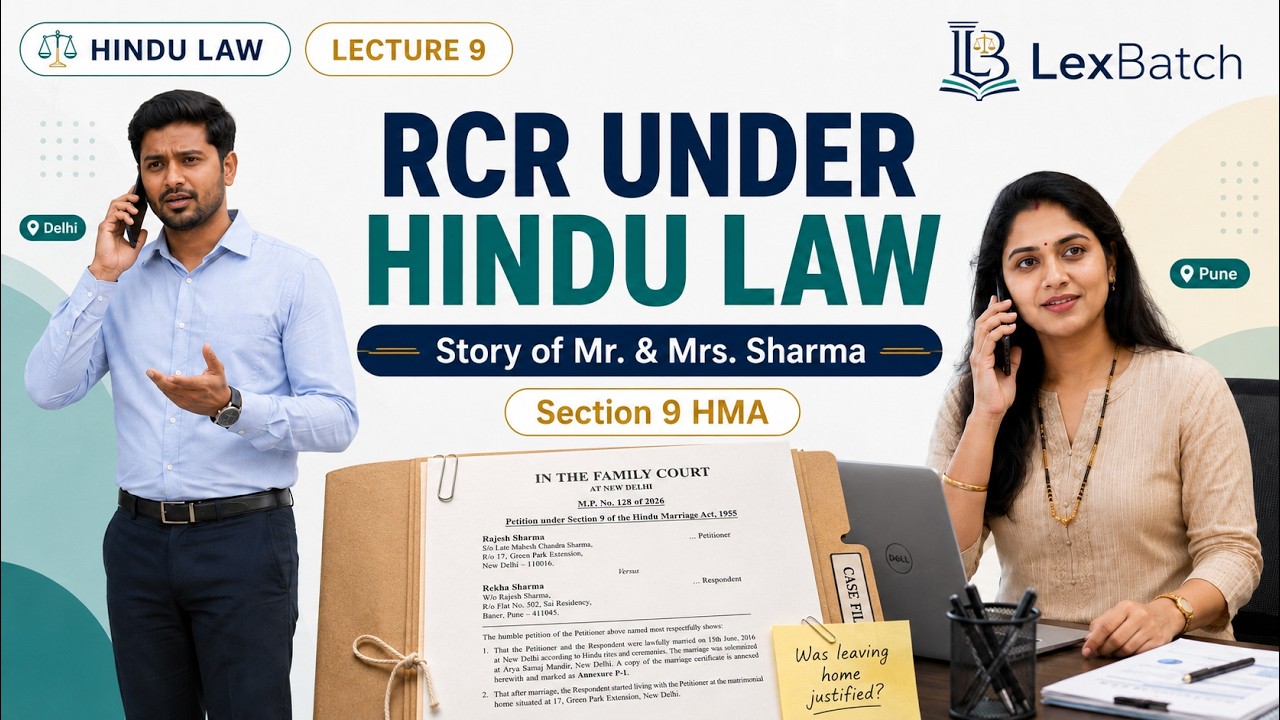
In the previous lecture, we ended with a real story: an actress, her marriage, and a petition filed by her husband asking the court to bring her back to matrimonial society. That petition was based on a provision recognised under the Hindu Marriage Act, 1955, under Section 9, known as restitution of conjugal rights (RCR).
Section 9 of the Hindu Marriage Act gives this remedy to a spouse when the other spouse has withdrawn from his or her society without reasonable excuse. But the moment we ask what a court is really ordering, the topic becomes much bigger than family law. It becomes a constitutional question: how far can law go in preserving marriage without violating personal liberty?
What is Restitution of Conjugal Rights?
Restitution means restoration. Conjugal rights refer to the rights and obligations arising from the marital relationship. Therefore, restitution of conjugal rights means restoration of marital society between husband and wife.
In simple terms, if one spouse has withdrawn from the society of the other without reasonable excuse, the aggrieved spouse may approach the District Court and ask for a decree directing the other spouse to resume marital cohabitation.
It is NOT a decree for specific performance. It is NOT a mandate for sexual intercourse. It is not a coercive action.
It is a restorative matrimonial remedy. However, it is much more than a restorative remedy. In practice, restitution of conjugal rights is frequently misunderstood as a purely restorative tool. In reality, it is often utilized strategically as a legal bridge to divorce. Under Section 13(1A)(ii) of the Hindu Marriage Act, if a decree for restitution of conjugal rights is passed and the parties fail to resume cohabitation for a period of one year or more, it automatically creates a statutory ground for either party to apply for a dissolution of marriage by way of divorce.
Section 9, Hindu Marriage Act, 1955
Essential Conditions for Granting Decree
A decree for restitution of conjugal rights is not automatic. The court must be satisfied that the statutory conditions are fulfilled.
There must be a valid marriage between the parties.
One spouse must have withdrawn from the society of the other.
The withdrawal must be without reasonable excuse.
The court must be satisfied about the truth of the statements made in the petition.
There must be no legal ground for refusing the relief.
Withdrawal from Society: Not Just Physical Separation
The phrase “withdrawal from society” is wider than merely living in a different place. The real question is whether the respondent has withdrawn from marital consortium — companionship, cohabitation, mutual support and the shared obligations of married life.
A spouse may be physically away for employment, medical treatment, family responsibility or other practical reasons. Such physical distance alone may not always amount to withdrawal from society. The court must look at intention, conduct and the surrounding facts.
Reasonable Excuse: When Refusal is Justified
Even if one spouse has withdrawn from the society of the other, the decree will not follow if there is a reasonable excuse. This is the most practical part of Section 9 litigation.
Possible reasonable excuses
- Cruelty or apprehension of harm
- Second marriage or illicit relationship
- Non-maintenance or neglect
- Unsafe matrimonial environment
- Conduct making cohabitation unreasonable
Question for court
Is the respondent refusing marital society without justification, or is the refusal a natural response to the petitioner’s conduct?
Burden of Proof under Section 9 Explanation
Section 9 contains a specific Explanation on burden of proof. Once the question arises whether there was reasonable excuse for withdrawal from society, the burden of proving reasonable excuse lies on the person who has withdrawn from society.
Petitioner shows withdrawal from society.
Respondent raises reasonable excuse.
Respondent must prove that reasonable excuse.
How is the Decree Enforced?
A common misunderstanding is that if a decree for restitution is passed, the spouse can be physically forced to return. That is not the correct position. The decree is not executed by bodily force neither such a decree is a validation for compelling sexual intercourse.
The remedy is enforced through civil consequences, particularly through the mechanism available under the Code of Civil Procedure. This limited mode of enforcement became a major reason for courts to describe Section 9 as a reconciliation-oriented remedy rather than a direct physical compulsion.
RCR and Divorce under Section 13(1A)
Section 9 looks like a remedy to preserve marriage. But in practice, it also connects with divorce. If there is no restitution of conjugal rights for the statutory period after the decree, it may become a ground for divorce under Section 13(1A).
As a litigator, this creates a question. Is the spouse genuinely trying to restore cohabitation? Or is the petition being used as a first step to create a future ground for divorce?
From High Court Conflict to Supreme Court Settlement
T. Sareetha
Andhra Pradesh High Court: Section 9 unconstitutional.
Harvinder Kaur
Delhi High Court: Section 9 constitutional.
Saroj Rani
Supreme Court: Section 9 upheld.
T. Sareetha v. T. Venkata Subbaiah
In this case, the husband filed a petition for restitution of conjugal rights against Sareetha, a well-known South Indian film actress. The Andhra Pradesh High Court treated Section 9 not merely as a matrimonial remedy, but as a serious constitutional problem.
The court held that compelling conjugal cohabitation against the will of an individual invades privacy, dignity and personal liberty. It saw Section 9 as a remedy that could force intimate association through the machinery of the State.
Can the State, through a civil decree, compel a person to resume intimate marital association without violating privacy and bodily autonomy?
Harvinder Kaur v. Harmander Singh Choudhry
Soon after T. Sareetha, the Delhi High Court took the opposite view. Justice Avadh Behari Rohatgi rejected the idea that a decree for restitution of conjugal rights is equivalent to forced sexual intercourse.
The court treated the remedy as one directed toward cohabitation, consortium and preservation of the marital bond. According to this view, courts do not and cannot enforce sexual intercourse; the decree is concerned with restoring marital society.
The Delhi High Court viewed Section 9 as a remedy for restoring consortium, not as a command for forced intimacy.
Saroj Rani v. Sudarshan Kumar Chadha
The conflict between the Andhra Pradesh High Court and the Delhi High Court was finally resolved by the Supreme Court in Saroj Rani v. Sudarshan Kumar Chadha.
In this case, the wife had obtained a decree for restitution of conjugal rights. Later, the husband sought divorce on the ground that there had been no resumption of cohabitation after the decree. Therefore, the case was not only about the constitutional validity of Section 9, but also about how a restitution decree may later interact with divorce under the Hindu Marriage Act.
The Supreme Court accepted the Delhi High Court’s approach and rejected the Andhra Pradesh High Court’s view. It held that Section 9 does not violate Articles 14 or 21 of the Constitution. The Court treated restitution of conjugal rights as a matrimonial remedy intended to bring about cohabitation and reconciliation, not as a decree enforcing sexual intercourse.
Section 9 of the Hindu Marriage Act remains constitutionally valid as per the Supreme Court decision in Saroj Rani.
Modern Debate after Privacy Jurisprudence
Although Saroj Rani remains the binding position, the constitutional debate has not disappeared. After the expansion of privacy, dignity and decisional autonomy in Indian constitutional law, restitution of conjugal rights continues to raise difficult questions.
Autonomy concern
Should a person’s intimate association with a spouse be subject to a court decree?
Marriage-law concern
Should courts preserve a remedy that may encourage reconciliation before divorce?
Key Takeaways
Restitution of conjugal rights is a matrimonial remedy under Section 9 of the Hindu Marriage Act, 1955.
The petitioner must show withdrawal from society without reasonable excuse.
Living separately does not automatically mean withdrawal from society; intention and conduct matter.
Reasonable excuse is a powerful defence against an RCR petition.
The decree is not enforced by physical force and does not validate compelled sexual intercourse.
Non-compliance with an RCR decree may later connect with divorce under Section 13(1A).
T. Sareetha treated Section 9 as unconstitutional on autonomy and privacy grounds.
Harvinder Kaur and later Saroj Rani upheld Section 9 as constitutionally valid.
Final Thought
Section 9 forces us to ask one of the most delicate questions in Hindu matrimonial law: when marriage breaks down, should law try to restore the relationship, or should it step back and protect individual choice?